
Should you buy a food scale?
Buy one if you regularly need ingredient weights, compare food with a label, or divide batch-cooked meals. Start with your usual bowl or plate if you mainly want an easier serving routine. A scale answers “how much does this weigh?” It cannot tell you how much your body needs or guarantee weight loss.
Our buying recommendation: choose a straightforward scale with grams, tare and a readable display. Consider a pull-out display if your mixing bowl repeatedly hides the numbers. Compare the two named options below →
“My usual serving changes every time.”
A rushed pour of oats on Monday may look different from Friday’s. Measuring a familiar ingredient can give you a reference. It does not mean every meal needs weighing from then on.
Try your normal bowl first. If you still want to know the amount in grams, that is a specific job a scale can do. If the bowl already gives you the consistency you wanted, there may be nothing to buy.
A portion is the amount you choose to eat. A serving size on a nutrition label is the amount used for the nutrition information; it is not automatically your recommended portion. NIDDK explains the distinction.
| Your situation | Practical starting point |
|---|---|
| A recipe gives amounts in grams | A digital scale avoids guessing from a different measure. |
| You want familiar weekday servings | Use the same bowl or serving spoon; add weighing only if it answers a useful question. |
| A large mixing bowl covers the display | A pull-out display addresses that particular nuisance. |
| You eat shared dishes or takeaway | Use a practical plate or bowl routine. Weighing a mixed dish will not reveal its ingredients. |
| Measuring makes eating stressful | Set the scale aside and seek individual support rather than adding more tracking. |
Three everyday examples
Breakfast before work
If the cereal label gives grams, place your empty bowl on the scale, press tare to return it to zero, then add cereal. That measures the cereal rather than the bowl. You can look at the amount in your usual dish and decide whether that reference is useful.
Packing rice for lunch
Not sure how many scoops to pack? Start with the amount you would normally eat, using the same level scoop each time. That gives you a practical reference without treating one number as right for everyone.
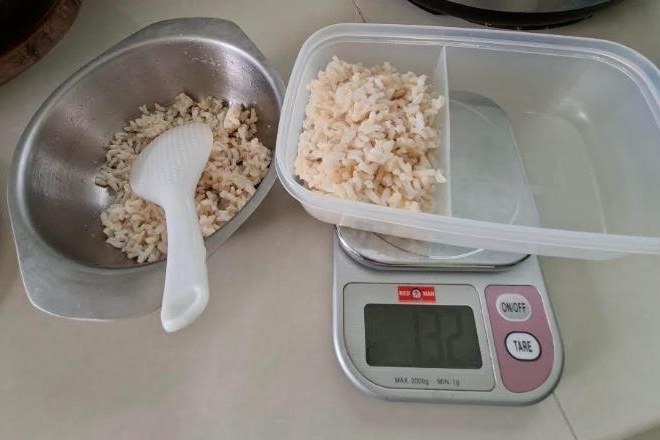
If you want to know the weight, place the empty lunch container on the scale and press tare before adding cooked rice. Note the amount once, then use your usual scoop for future lunches if that feels easier. Adjust the amount to your appetite, the rest of the meal and any individual advice you follow.
Dividing a batch recipe
If you have cooked rice for several lunches, weigh the cooked rice and divide the total by the number of containers. This makes the containers more alike; it does not determine the right amount for each person. Use cooked-rice information with cooked weight—water changes rice’s weight during cooking.
A family dinner with several dishes
Rice, fish and vegetables arrive on the table together. You may find a familiar plate and serving spoon more convenient than stopping to weigh each component. For an approach without numbers, see our everyday portion guide and balanced-plate guide.
Check these features before spending
- Tare/zero: weigh food in your own container without including its weight.
- Display position: picture your widest plate on the platform. Could you still see the numbers?
- Capacity: allow for both food and the container; a heavy bowl uses part of the allowance.
- Units and increments: choose grams if that is what your recipes use. A 1-gram display increment is not proof of laboratory accuracy.
- Cleaning and storage: follow the care instructions and check whether it fits where you will keep it.
- Power and auto-off: check battery type, replacement availability and whether the shut-off timing suits your cooking pace.
For ordinary kitchen weighing, start with those basics. Pay for app features only if you can name a task they make easier.
Two scales to compare—and why you might choose each
Affiliate disclosure: We may earn a commission from qualifying purchases through the Amazon links below. As an Amazon Associate I earn from qualifying purchases.
These are feature-based selections from manufacturer descriptions, not hands-on test results. We have not independently measured accuracy or durability. The links open model-specific Amazon searches; match the model and seller before ordering.
For routine weighing: OXO Good Grips Everyday Glass Food Scale, 11 lb/5 kg
Why consider it: OXO lists a tare function, gram units, a large backlit display and a wipe-clean glass platform. This is the first option to compare if your problem is simply weighing ingredients in a modest-sized bowl.
Trade-off: the display stays in the base. Check whether your usual bowl would cover it, and whether a glass platform suits how you store and handle kitchen tools.
Our take: its basic weighing features are a sensible starting point; compare the delivered price before paying for extras.
Check Everyday Glass scale prices on Amazon →For bowls that hide the numbers: OXO Good Grips 11 lb Stainless Steel Food Scale with Pull-Out Display
Why consider it: the display pulls away from the base so a wide bowl is less likely to obstruct it. OXO also lists tare, a backlit display and 1-gram measurement increments.
Trade-off: the pull-out mechanism is an extra feature to clean and store. If you only weigh small bowls, you may not need it; compare the price difference with the simpler model.
Our take: choose this design for the display-access problem, rather than expecting it to deliver better health results.
Check pull-out display scale prices on Amazon →International readers: these links open Amazon.com. Delivery varies by seller and country. Compare shipping, taxes, import charges, returns and the final checkout total. Local stores may offer a better total price. No Amazon stock or price is guaranteed here.
How to use a scale without making meals a project
- Choose one question, such as the weight of your usual breakfast ingredient.
- Set the scale on a firm, level surface. Select the correct unit.
- Add your empty container and press tare. Add the food and read the weight.
- When using labels or food records, match the food’s state: dry, raw or cooked. Do not apply dry-rice information to cooked-rice weight.
- Keep measuring only if it remains useful. You can still use ordinary dishes at other meals.
A scale measures mass, not calories or nutritional quality. Nutrition estimates depend on the food information you use. If you follow a medical eating plan, ask your clinician or registered dietitian which measurements matter. If tracking causes distress or you have an eating-disorder history, get individual guidance before using it for portion control.
The decision: buy a scale to solve a repeatable measuring problem. If you cannot name one yet, try your existing bowl and spoon first.
Questions before you buy
Do I need to weigh every meal to manage portions?
No. A food scale is optional. You can use familiar dishes for everyday meals and weigh selected ingredients when a recipe or label makes grams useful.
Should I weigh rice before or after cooking?
Match the weight to the information you are using. Dry-rice information belongs with dry weight; cooked-rice information belongs with cooked weight. Water changes the weight during cooking.
What is tare on a food scale?
Tare resets the displayed weight to zero after you add an empty container, allowing you to measure the food without including the container. The container still counts toward the scale’s maximum capacity.
Which of these two scale designs should I choose?
Compare the Everyday Glass model for basic ingredient weighing. Consider the pull-out-display model if large bowls obscure the numbers. Check current model details, delivered prices and return terms before deciding.
Will buying a food scale make me lose weight?
No. A scale can help you understand quantities, but owning or using one does not guarantee weight loss. Food needs and appropriate approaches vary between people.
Sources and how we chose
Product features were checked against the manufacturer pages below on 31 October 2026. The selections reflect practical design differences, not a tested ranking. Prices are left to the retailer because they change. Health information is general education, not personalised advice.
- NIDDK: Food Portions—Choosing Just Enough for You (portion and serving definitions; flexible measuring).
- OXO: Everyday Glass Food Scale, 11 lb/5 kg (manufacturer specifications).
- OXO: Stainless Steel Food Scale with Pull-Out Display (manufacturer specifications).