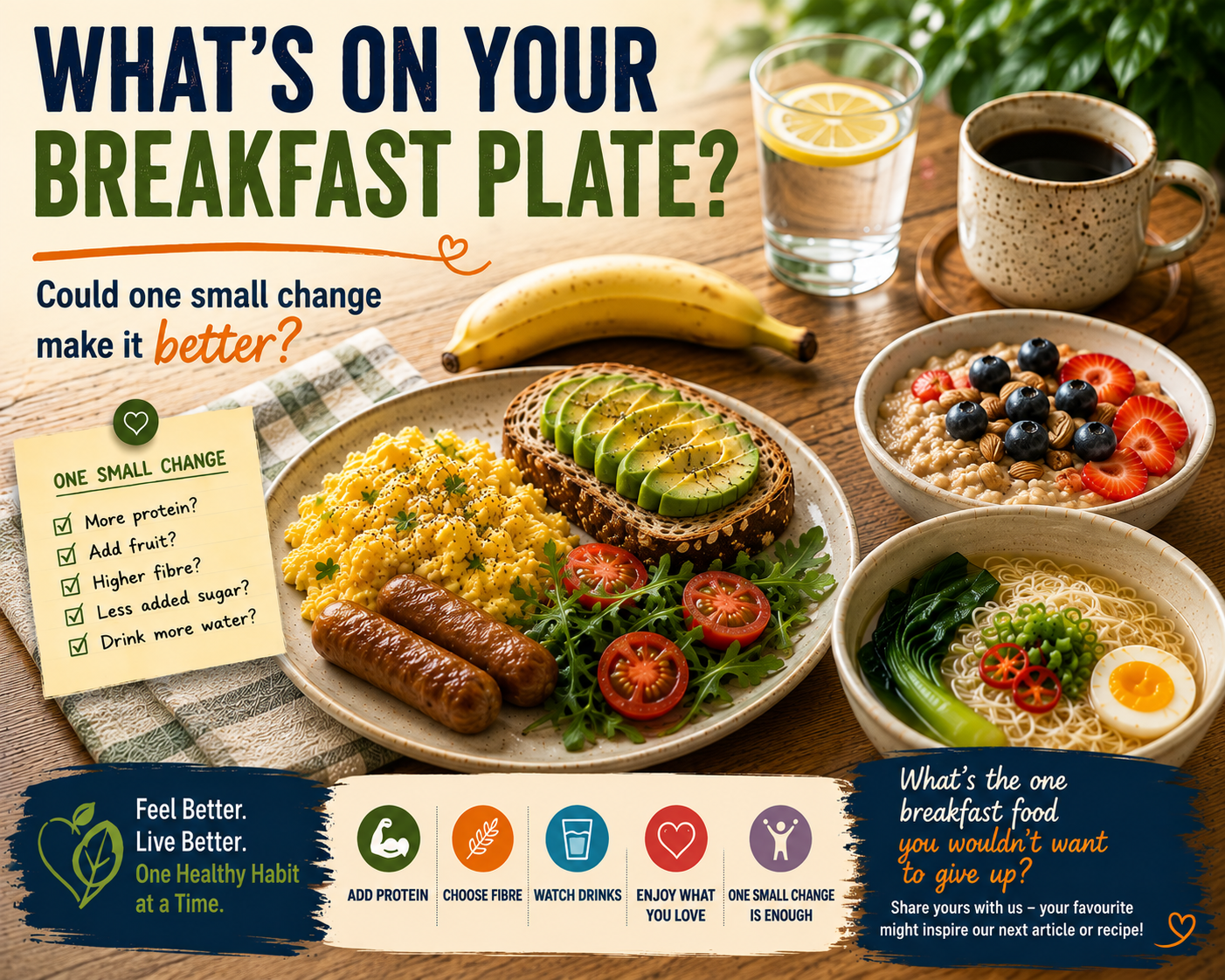
Breakfast can look very different from one person to another.
For some, it’s eggs and toast. For others, it might be oats, noodles, rice, fruit, or simply coffee before rushing out the door.
And that’s perfectly normal.
Quick take
A healthier breakfast doesn’t have to mean replacing everything you enjoy with a completely different meal. Sometimes, one small change is enough to move breakfast in a better direction.
Start With What You Already Eat
Take a quick look at your usual breakfast.
Instead of asking, “Is this healthy or unhealthy?”, try asking: “What is one thing I could improve?”
Perhaps your breakfast could use a little more protein. Maybe some fruit or fibre. Perhaps your morning drink contains more added sugar than you realised.
Or maybe your breakfast is already fairly balanced—and the best change is simply making time to eat it more regularly.
There is no need to change everything at once.
1. Could You Add Some Protein?
Protein can help make breakfast more satisfying.
Depending on what you enjoy and what fits your lifestyle, breakfast protein might come from eggs, plain yogurt, milk, tofu, beans, nuts, seeds or other foods.
If breakfast is normally just toast or a piece of fruit, you don’t necessarily have to give those up. You could simply add something.
2. Could You Add More Fibre?
Whole grains, oats, fruit, vegetables, nuts and seeds can all contribute fibre.
Again, this doesn’t require rebuilding breakfast. If you enjoy toast, you might sometimes choose a higher-fibre bread. If you eat oats, add some fruit. If noodles or rice are your normal breakfast, adding some vegetables can be another simple step.
Keep it familiar
Improve the meal you already enjoy rather than trying to turn it into somebody else’s breakfast.
3. What About Processed Breakfast Foods?
Here’s where our breakfast plate gets interesting.
Sausages, luncheon meats and other processed meats are convenient—and many people enjoy them. We don’t need to pretend otherwise.
The question isn’t necessarily “Must I stop eating this?” A more useful question might be: “Do I need to eat it as often?”
For example, someone who loves eggs and sausages could keep the eggs and enjoy the sausages less frequently, or sometimes swap them for another protein choice.
That’s very different from declaring your favourite breakfast “forbidden.” At VibrantLife4U, we’re much more interested in better habits that you can actually live with.
4. Don’t Forget What You’re Drinking
Breakfast isn’t only about what’s on the plate.
Coffee, tea, juice and other drinks can contribute added sugar depending on how they’re prepared.
You don’t necessarily have to abandon your morning coffee. Could you use a little less sugar? Choose an unsweetened option occasionally? Or simply have a glass of water alongside breakfast?
Again—one small change.
5. Keep the Foods You Love
If someone told you that “healthy eating” meant permanently giving up your favourite breakfast, how long would you realistically want to continue?
Healthy habits work better when they fit into real life. So keep the foods you enjoy. Then look for small ways to create a little more balance around them.
A bowl of noodles doesn’t automatically need replacing with oats. Rice doesn’t have to disappear because someone on the internet says breakfast should be avocado toast. And enjoying a sausage occasionally doesn’t mean you’ve ruined your breakfast.
Different cultures, families and individuals eat differently—and healthy eating has room for that.
Your One Small Change Challenge
Tomorrow morning, look at your breakfast before you eat it. Don’t judge it. Don’t redesign the whole plate.
Just ask yourself: Could I make ONE small change today?
One is enough
Because healthier living doesn’t have to begin with a dramatic transformation. Sometimes it begins with breakfast.
Health disclaimer: This article provides general educational information only. It is not medical advice and should not be used to diagnose, treat, cure or prevent any condition. Individual needs and responses vary. Consult a qualified healthcare professional for advice based on your health history and circumstances.